
Webinar

Autonomous HL‑20 Model Creation: From Specification to Simulation

Webinar

Autonomous HL‑20 Model Creation: From Specification to Simulation

Event Date & Time

EDT

Speakers

Share

Event Date & Time

EDT

Speakers

Share

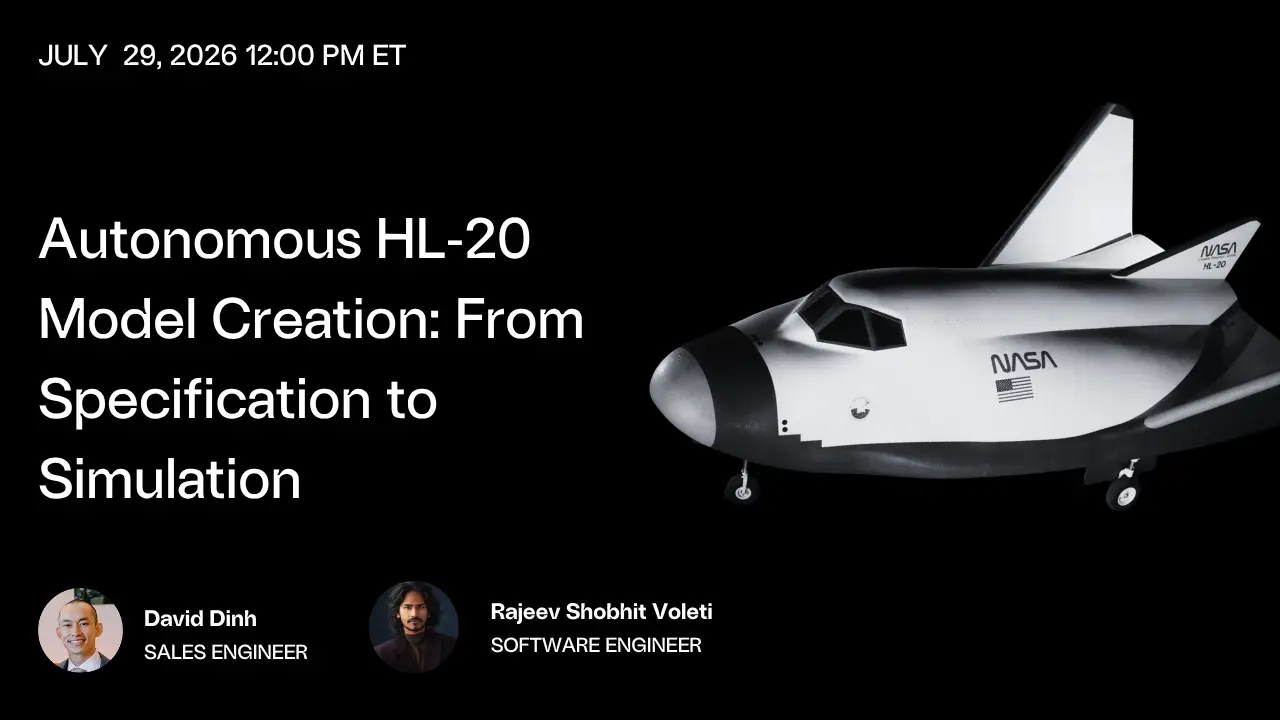
What does it take to go from a complex engineering specification document to a validated, physics-enforced simulation model, without hand-building it line by line? In this live webinar, we demonstrate the Dyad Agent's ability to turn dense technical documentation into working, verified simulation models.  

For our working example, we'll use one of aerospace engineering's most richly documented benchmark vehicles: the NASA HL-20 lifting-body Personnel Launch System. The HL-20, a hypersonic re-entry vehicle designed for crewed Space Station missions, comes with decades of NASA technical documentation spanning aerodynamics, inertias, guidance and control laws, and simulation trim cases. It's exactly the kind of complex, multi-domain system that exposes the limits of general-purpose AI code generation, which makes it a good stress test for what the Dyad Agent can do.  

We'll show how the Dyad Agent reasons over that specification and constructs a validated Dyad model around it, selecting appropriate causal and acausal modeling strategies and iterating toward a verified result without manual trial and error. Throughout, Dyad's compiler-backed constraint system enforces physical correctness at every step, catching unit inconsistencies, conservation law violations, and type errors before simulation ever runs. We'll walk through what the agent does, where it self-corrects, and how the resulting model holds up against NASA's own published trim and dynamic check cases.  

This same capability extends well beyond aerospace. Any engineer working from complex, multi-domain specification documents will recognize the challenge of turning that documentation into a working model, and what it means to have an agent handle that translation directly.  

Key takeaways: 

  • A demonstration of end-to-end model creation from NASA HL-20 documentation 

  • How the Dyad Agent reasons over complex engineering specifications to construct a working model 

  • How to validate AI-generated models against published reference data

Speakers

David Dinh is a Sales Engineer at JuliaHub, with extensive experience in aerospace and engineering. His focus is on advancing modeling and simulation engineering solutions for enterprise customers. Earlier in his career, he served as an engineer in the U.S. Air Force. David holds an M.S. in Computer Science from the University of Southern California and an M.S. in Aeronautical Engineering from the Air Force Institute of Technology.

Ph.D. graduate in Aerospace Engineering from the University of Texas at Arlington, specializing in Multi-Agent Cooperative Control. Advancing model predictive control techniques and exploring the potential of scientific machine learning in the aerospace field.

Speakers

David Dinh is a Sales Engineer at JuliaHub, with extensive experience in aerospace and engineering. His focus is on advancing modeling and simulation engineering solutions for enterprise customers. Earlier in his career, he served as an engineer in the U.S. Air Force. David holds an M.S. in Computer Science from the University of Southern California and an M.S. in Aeronautical Engineering from the Air Force Institute of Technology.

Ph.D. graduate in Aerospace Engineering from the University of Texas at Arlington, specializing in Multi-Agent Cooperative Control. Advancing model predictive control techniques and exploring the potential of scientific machine learning in the aerospace field.

Speakers

David Dinh is a Sales Engineer at JuliaHub, with extensive experience in aerospace and engineering. His focus is on advancing modeling and simulation engineering solutions for enterprise customers. Earlier in his career, he served as an engineer in the U.S. Air Force. David holds an M.S. in Computer Science from the University of Southern California and an M.S. in Aeronautical Engineering from the Air Force Institute of Technology.

Ph.D. graduate in Aerospace Engineering from the University of Texas at Arlington, specializing in Multi-Agent Cooperative Control. Advancing model predictive control techniques and exploring the potential of scientific machine learning in the aerospace field.

Sign Up

Register below to get event details sent to you.

We’ll use your information to host this webinar and send essential communications. You can also choose to receive our newsletter and updates—just check the box above. You can unsubscribe anytime. Read more in our Privacy Policy.

America/New_York

Sign Up

Register below to get event details sent to you.

We’ll use your information to host this webinar and send essential communications. You can also choose to receive our newsletter and updates—just check the box above. You can unsubscribe anytime. Read more in our Privacy Policy.

America/New_York

/

/

Autonomous HL‑20 Model Creation: From Specification to Simulation