

Julia

The Standard for Technical and Scientific Computing

Julia is a high-performance programming language designed from the ground up for numerical computing, data science, and scientific machine learning.

Julia

The Standard for Technical and Scientific Computing

Julia is a high-performance programming language designed from the ground up for numerical computing, data science, and scientific machine learning.

Julia

The Standard for Technical and Scientific Computing

Julia is a high-performance programming language designed from the ground up for numerical computing, data science, and scientific machine learning.

Community

Powered by a Thriving Open Source Ecosystem

Born out of MIT roots to global adoption, Julia benefits from a unique ecosystem where academic researchers, industry practitioners, and open source contributors collaborate to push the boundaries of scientific computing.

Community

Powered by a Thriving Open Source Ecosystem

Born out of MIT roots to global adoption, Julia benefits from a unique ecosystem where academic researchers, industry practitioners, and open source contributors collaborate to push the boundaries of scientific computing.

100M+

Downloads

13K+

Packages

1,500+

Universities

100M+

Downloads

13K+

Packages

1,500+

Universities

100M+

Downloads

13K+

Packages

1,500+

Universities

Julia Benefits

  • Vibrant Open-Source Ecosystem

    Julia’s expansive and continuously growing ecosystem fosters collaboration and accelerates code deployment. Its readability and maintainability ensure long-term sustainability of projects.

  • High Performance

    Julia’s just-in-time (JIT) compilation system delivers lightning-fast execution, with performance gains of 100-1000x over legacy languages making it an ideal choice for HPC applications in computing solutions.

  • Ease of Use

    Julia’s intuitive syntax is easy to learn for developers familiar with Python or MATLAB, enabling rapid skill acquisition and minimizing training time.

  • Advanced Parallelism

    Built-in support for parallel computing allows for efficient execution of concurrent tasks, maximizing resource utilization and reducing project timelines.

  • Math-Friendly Syntax

    Julia’s syntax is tailored for complex mathematical operations, streamlining the development process for scientific and engineering applications.

  • Automatic Differentiation

    Simplify the creation of algorithms and models that require gradients and derivatives, reducing coding complexity and enhancing model accuracy.

  • Native GPU Support

    Harness the full potential of GPUs to accelerate computational tasks and simulations, driving innovation in data-intensive projects.

Julia Benefits

  • Vibrant Open-Source Ecosystem

    Julia’s expansive and continuously growing ecosystem fosters collaboration and accelerates code deployment. Its readability and maintainability ensure long-term sustainability of projects.

  • High Performance

    Julia’s just-in-time (JIT) compilation system delivers lightning-fast execution, with performance gains of 100-1000x over legacy languages making it an ideal choice for HPC applications in computing solutions.

  • Ease of Use

    Julia’s intuitive syntax is easy to learn for developers familiar with Python or MATLAB, enabling rapid skill acquisition and minimizing training time.

  • Advanced Parallelism

    Built-in support for parallel computing allows for efficient execution of concurrent tasks, maximizing resource utilization and reducing project timelines.

  • Math-Friendly Syntax

    Julia’s syntax is tailored for complex mathematical operations, streamlining the development process for scientific and engineering applications.

  • Automatic Differentiation

    Simplify the creation of algorithms and models that require gradients and derivatives, reducing coding complexity and enhancing model accuracy.

  • Native GPU Support

    Harness the full potential of GPUs to accelerate computational tasks and simulations, driving innovation in data-intensive projects.

Julia Benefits

  • Vibrant Open-Source Ecosystem

    Julia’s expansive and continuously growing ecosystem fosters collaboration and accelerates code deployment. Its readability and maintainability ensure long-term sustainability of projects.

  • High Performance

    Julia’s just-in-time (JIT) compilation system delivers lightning-fast execution, with performance gains of 100-1000x over legacy languages making it an ideal choice for HPC applications in computing solutions.

  • Ease of Use

    Julia’s intuitive syntax is easy to learn for developers familiar with Python or MATLAB, enabling rapid skill acquisition and minimizing training time.

  • Advanced Parallelism

    Built-in support for parallel computing allows for efficient execution of concurrent tasks, maximizing resource utilization and reducing project timelines.

  • Math-Friendly Syntax

    Julia’s syntax is tailored for complex mathematical operations, streamlining the development process for scientific and engineering applications.

  • Automatic Differentiation

    Simplify the creation of algorithms and models that require gradients and derivatives, reducing coding complexity and enhancing model accuracy.

  • Native GPU Support

    Harness the full potential of GPUs to accelerate computational tasks and simulations, driving innovation in data-intensive projects.

Comparison

What Makes Julia Different

Julia's unique design delivers superior speed, simplicity, and scientific computing capabilities compared to traditional programming languages.

Comparison

What Makes Julia Different

Julia's unique design delivers superior speed, simplicity, and scientific computing capabilities compared to traditional programming languages.

Julia vs MATLAB

MATLAB users will feel right at home. Familiar syntax, excellent support for arrays and numerics. And Julia is open source with a vibrant package ecosystem and community. The only problem: unlearning your fear of loops. Julia has native C performance even for scalar code.

Julia vs MATLAB

MATLAB users will feel right at home. Familiar syntax, excellent support for arrays and numerics. And Julia is open source with a vibrant package ecosystem and community. The only problem: unlearning your fear of loops. Julia has native C performance even for scalar code.

Julia vs Python

Julia has the productivity and dynamicness of Python but with the speed and scale of C. No GIL limitations, true multithreading, and 50x+ speed improvements for numerical computing without sacrificing readability.

Julia vs Python

Julia has the productivity and dynamicness of Python but with the speed and scale of C. No GIL limitations, true multithreading, and 50x+ speed improvements for numerical computing without sacrificing readability.

Julia vs R

Julia provides R-like statistical capabilities with dramatically faster execution. 1-based indexing, better memory management, and native support for parallel computing make Julia ideal for large-scale data analysis.

Julia vs R

Julia provides R-like statistical capabilities with dramatically faster execution. 1-based indexing, better memory management, and native support for parallel computing make Julia ideal for large-scale data analysis.

Julia vs C/C++

Julia delivers near-C performance with high-level syntax. Automatic memory management, dynamic typing, and interactive development eliminate C++'s complexity while maintaining speed for computational tasks.

Julia vs C/C++

Julia delivers near-C performance with high-level syntax. Automatic memory management, dynamic typing, and interactive development eliminate C++'s complexity while maintaining speed for computational tasks.

Julia vs Fortran

Julia matches Fortran's numerical performance with modern language features. Dynamic typing, interactive REPL, and extensive package ecosystem provide scientific computing power without Fortran's dated syntax.

Julia vs Fortran

Julia matches Fortran's numerical performance with modern language features. Dynamic typing, interactive REPL, and extensive package ecosystem provide scientific computing power without Fortran's dated syntax.

Julia vs Mathematica

Julia provides symbolic and numerical computing like Mathematica with faster execution and open-source accessibility. Better performance for large computations, extensive package ecosystem, and no expensive licensing required.

Julia vs Mathematica

Julia provides symbolic and numerical computing like Mathematica with faster execution and open-source accessibility. Better performance for large computations, extensive package ecosystem, and no expensive licensing required.

Packages

Julia Package Ecosystem

Explore the powerful libraries that make Julia the go-to language for scientific computing, data science, and high-performance applications

Packages

Julia Package Ecosystem

Explore the powerful libraries that make Julia the go-to language for scientific computing, data science, and high-performance applications

Scientific Machine Learning (SciML)

Differential equations, neural ODEs, and physics-informed ML for next-generation scientific computing and digital twins

Mathematical Optimization (JuMP)

Linear, nonlinear, and mixed-integer optimization with algebraic modeling language for complex decision problems

Data & Statistics

High-performance DataFrames, statistical analysis, and data manipulation tools for modern data science workflows

Visualization & Graphics

Interactive plotting with Makie and comprehensive charting with Plots for publication-quality visualizations

GPU & High-Performance Computing

Native GPU programming with CUDA.jl, distributed computing, and parallel processing for accelerated computing

Machine Learning & AI

Native ML with Flux/Lux, probabilistic programming, and deep learning frameworks built for performance

In-Person Community

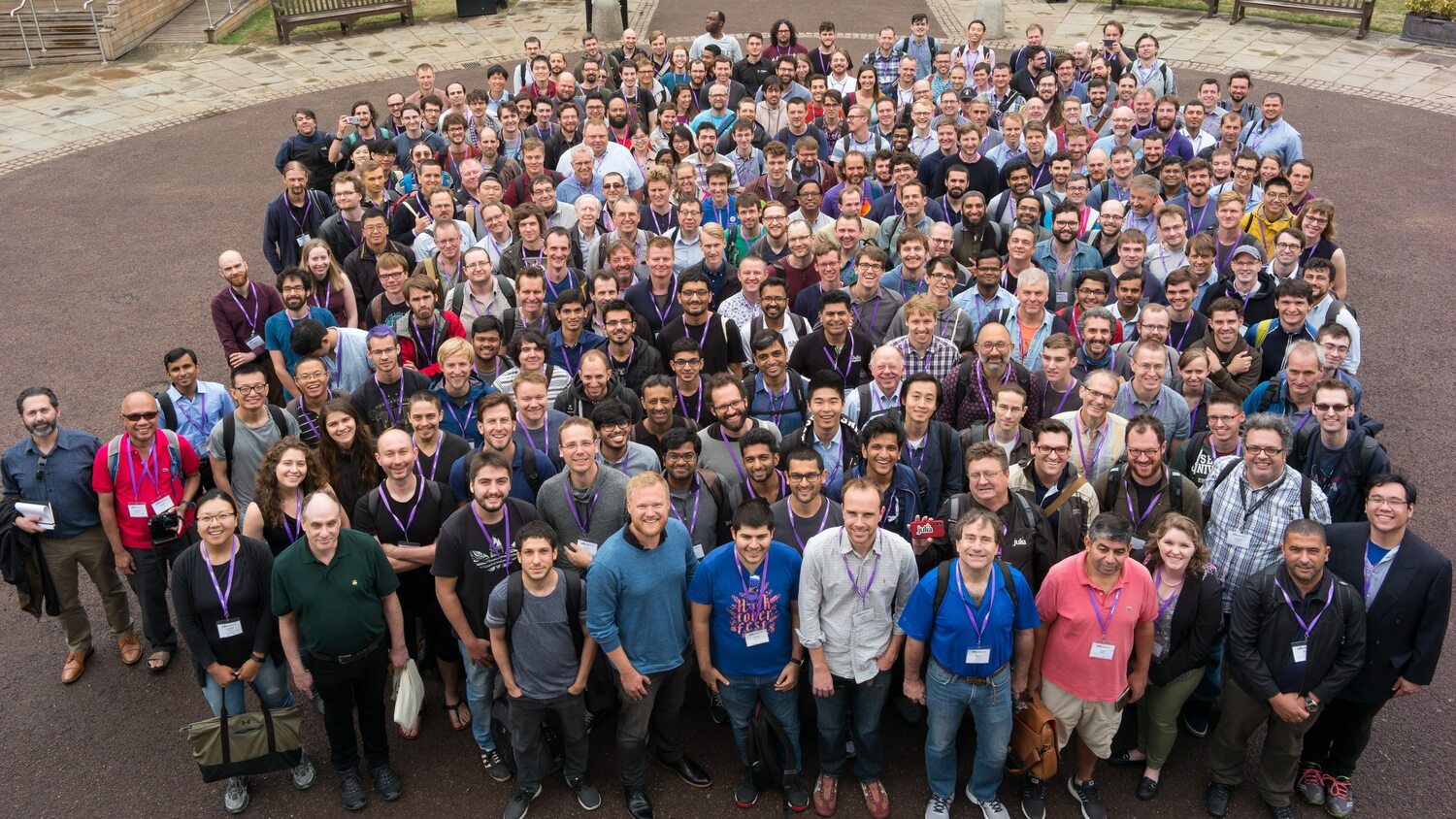
JuliaCon

Annual event that brings together developers, researchers, and enthusiasts from around the globe to celebrate and explore the power and versatility of Julia

In-Person Community

JuliaCon

Annual event that brings together developers, researchers, and enthusiasts from around the globe to celebrate and explore the power and versatility of Julia

Frequently Asked Questions

Answers to common questions about Julia

Frequently Asked Questions

Answers to common questions about Julia

What is Julia?

Julia is a high-performance programming language designed from the ground up for numerical computing, data science, and scientific machine learning, combining ease of use with C-like execution speed.

Is Julia free to use?

Yes, Julia is a free, open-source programming language that can be installed from julialang.org/downloads.

What is Julia used for in scientific computing?

Julia is used for Scientific Machine Learning (SciML) such as differential equations, neural ODEs, and physics-informed ML; mathematical optimization via JuMP; high-performance data and statistics workflows with DataFrames.jl; visualization with Makie and Plots; GPU and distributed high-performance computing; and native machine learning with Flux, Lux, and probabilistic programming frameworks like Turing.jl.

How does Julia compare to R, C/C++, and Fortran?

Julia provides R-like statistical capabilities with dramatically faster execution and native parallel computing support. Compared to C/C++, Julia delivers near-C performance with high-level syntax, automatic memory management, and interactive development. Compared to Fortran, Julia matches its numerical performance while adding dynamic typing, an interactive REPL, and a modern package ecosystem.

How does Julia compare to MATLAB?

MATLAB users generally feel at home in Julia thanks to its familiar syntax and strong support for arrays and numerics. Julia is open source with a vibrant package ecosystem and community, and it delivers native C-like performance even for scalar code and loops.

How does Julia compare to Python?

Julia has the productivity and dynamicness of Python but with the speed and scale of C. It has no GIL limitations, offers true multithreading, and delivers 50x+ speed improvements for numerical computing without sacrificing readability.

How large is the Julia community and package ecosystem?

Julia has over 100 million downloads, more than 1 million users, over 13,000 packages, and is used at 1,500+ universities.
Contact Sales

Learn about our products, pricing, implementation, and how JuliaHub can help your business

We’ll use your information to respond to your inquiry and, if applicable, classify your interest for relevant follow-up regarding our products. If you'd like to receive our newsletter and product updates, please check the box above. You can unsubscribe at any time. Learn more in our Privacy Policy.

Get a Demo

Discover how Dyad, JuliaHub, and Pumas can improve your modeling and simulation workflows.

Enterprise Support

Leverage our developers, engineers and data scientists to help you build new solutions.

Custom Solutions

Have a complex setup that needs a custom solution? We are here to help.

Contact Sales

Learn about our products, pricing, implementation, and how JuliaHub can help your business

We’ll use your information to respond to your inquiry and, if applicable, classify your interest for relevant follow-up regarding our products. If you'd like to receive our newsletter and product updates, please check the box above. You can unsubscribe at any time. Learn more in our Privacy Policy.

Contact Sales

Learn about our products, pricing, implementation, and how JuliaHub can help your business

We’ll use your information to respond to your inquiry and, if applicable, classify your interest for relevant follow-up regarding our products. If you'd like to receive our newsletter and product updates, please check the box above. You can unsubscribe at any time. Learn more in our Privacy Policy.

Get a Demo

Discover how Dyad, JuliaHub, and Pumas can improve your modeling and simulation workflows.

Enterprise Support

Leverage our developers, engineers and data scientists to help you build new solutions.

Custom Solutions

Have a complex setup that needs a custom solution? We are here to help.