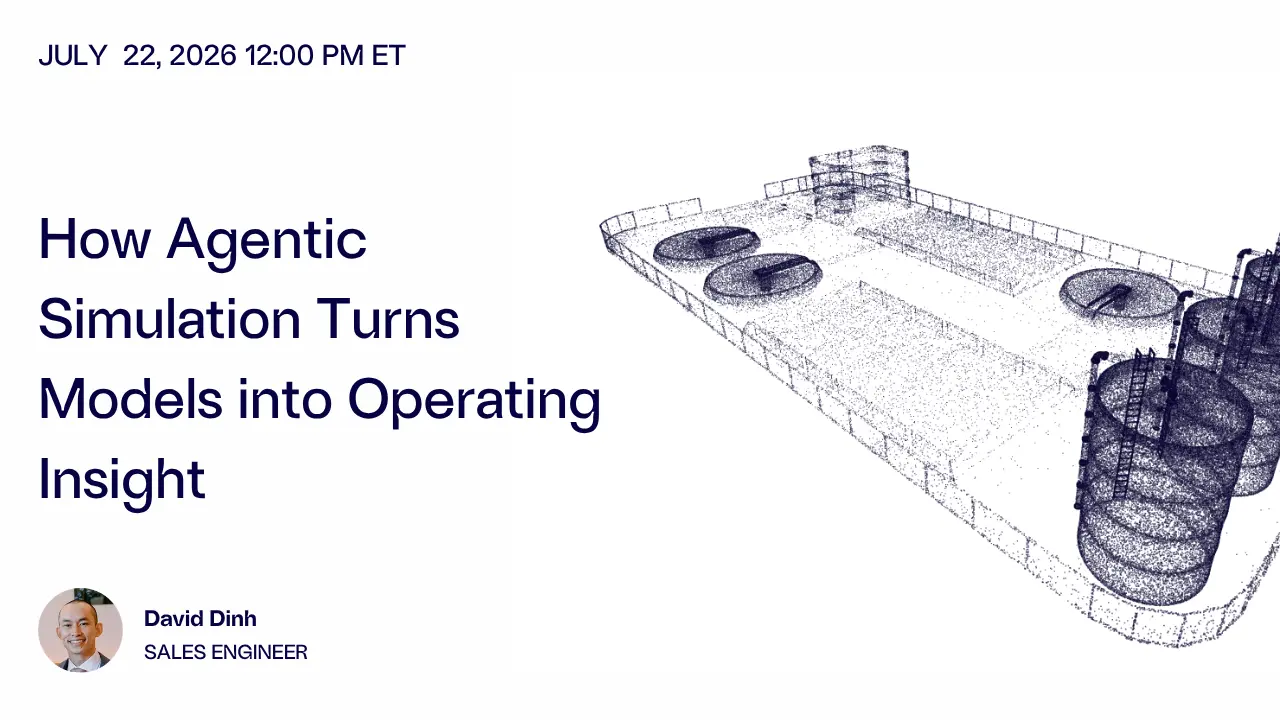
Engineers working with complex physical systems constantly face the same challenge: finding the right operating conditions among competing constraints. Push one variable to improve performance, and you often degrade another; trading cost, safety, output quality, resource use. Identifying the right operating zone has traditionally required deep modeling expertise, manual tuning, and hard-won operator experience. In this webinar, we show how the Dyad Agent changes that equation.
We'll use an activated sludge process for wastewater treatment as our working example. This process is one of the most widely used biological treatment systems in municipal and industrial settings. It's a great showcase because it has a clean, relatable tradeoff at its core: too little aeration and effluent quality falls short of regulatory standards; too much and you're burning energy and budget on air that isn't needed. Using this model, we'll demonstrate how the Dyad Agent can simulate, interrogate, and modify a working process model in real time through natural language. You'll watch the Agent adjust model parameters, explain the physical consequences of those changes, and execute a full parameter sweep across aeration rates to map the tradeoff between energy input and effluent quality at the outlet.
The workflow on display here (i.e. modifying, simulating, sweeping, reevaluating operating conditions) applies far beyond wastewater. Any engineer working with complex physical systems will recognize the challenge of identifying the right conditions to run them, and the opportunity that agentic simulation represents.
Key takeaways:
How engineers can move faster from model changes to insight
How the Dyad Agent modifies and simulates an existing process model through natural language
What agentic AI-driven tradespace exploration looks like applied to real-world engineering models